The AI Layer

Where AI fits into the broader platform ecosystem.

Not AI for AI's Sake

Every AI system I build follows three core principles: it must be safe by design, fully auditable, and deliver measurable business value. AI in operations should enhance human decision-making, not replace human judgment.
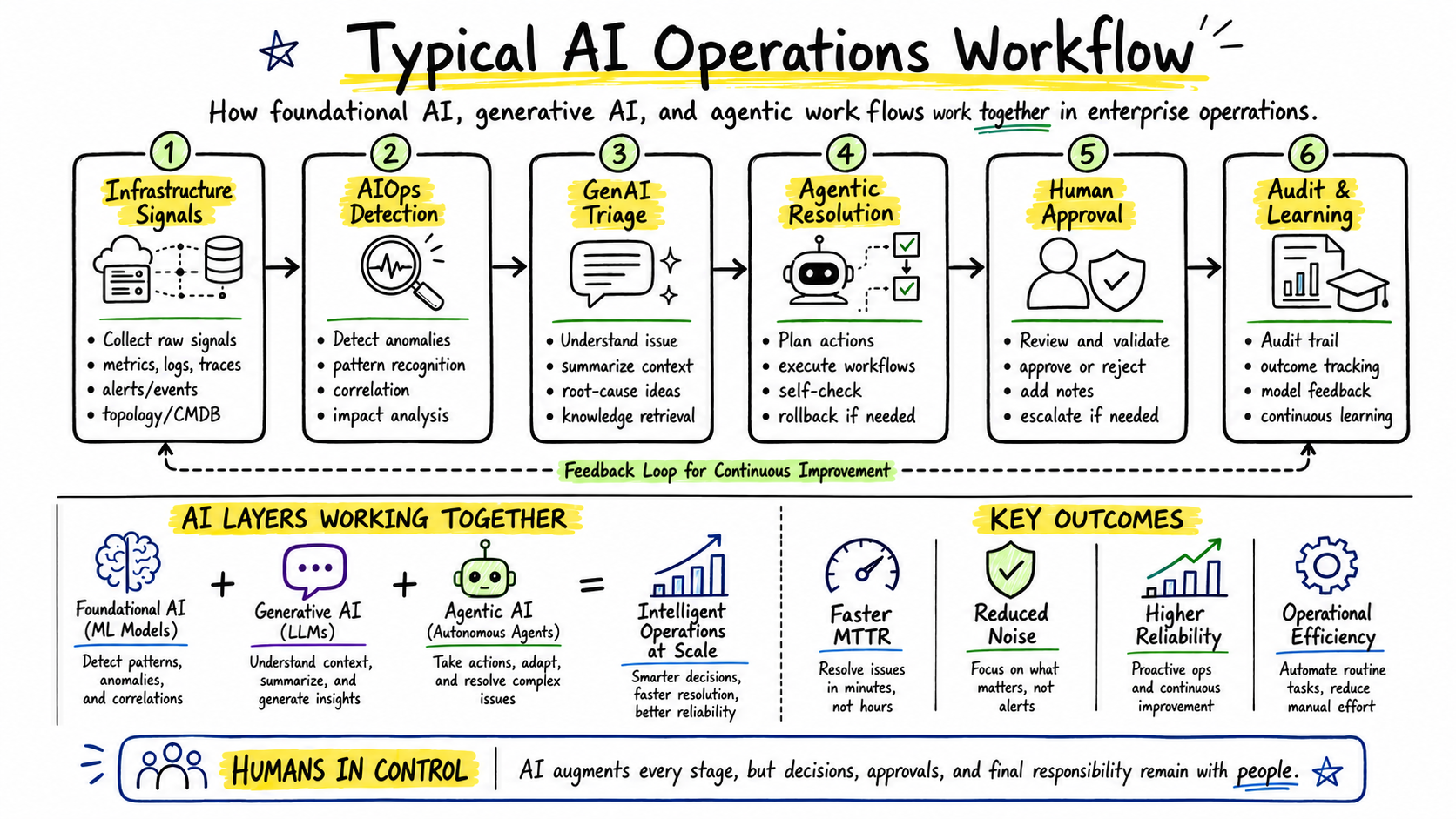
Typical AI Operations Workflow

AIOps & Intelligent Automation

AI-native operations that learn from your infrastructure patterns to predict issues before they impact users. Incorporates agentic AI workflows and LLMOps patterns for automated signal triage.

  • Anomaly detection for metrics and logs
  • Predictive scaling based on traffic patterns
  • Intelligent alert correlation and noise reduction
  • Root cause analysis acceleration

Governed AI & Assistants

Enterprise-grade AI governance ensuring safe, compliant, and controlled AI adoption across development teams.

  • Policy-based guardrails for AI assistants
  • Data loss prevention in AI workflows
  • Usage analytics and compliance reporting
  • Safe adoption playbooks and training

Advisory AI Systems

AI that advises rather than acts autonomously. Human-in-the-loop for critical decisions with full transparency.

  • Recommendation engines with confidence scores
  • Decision support with explainability
  • Rollback capabilities on all AI actions
  • Complete audit trails for compliance

MLOps & Model Governance

Production-grade machine learning and agentic AI pipelines with proper versioning, monitoring, and governance throughout the model lifecycle. Covers both traditional ML and LLMOps patterns for agentic operations.

  • Model registry and version control
  • Automated model validation and testing
  • Drift detection and performance monitoring
  • Bias detection and fairness metrics

Intelligent Automation

Smart automation that learns from patterns and adapts to changing conditions while maintaining safety guardrails.

  • Self-healing infrastructure responses
  • Automated incident triage and routing
  • Intelligent deployment strategies
  • Cost optimization recommendations

Conversational AI

Natural language interfaces for platform operations, making complex systems accessible to all team members.

  • ChatOps for infrastructure management
  • Natural language queries for observability
  • Guided troubleshooting assistants
  • Knowledge base integration

Generative & Agentic AI

From prompt engineering to multi-agent orchestration, including LLMOps and fine-tuning — building GenAI systems that integrate safely into enterprise platforms

Generative AI (GenAI)

GenAI integrations for engineering workflows - code generation, documentation, incident summaries, and platform self-service through natural language.

  • Assistant governance and usage policies
  • Prompt engineering for platform operations
  • GenAI-assisted runbooks and KB articles
  • Output validation and hallucination controls

LLMOps & Fine-Tuning

Production-grade lifecycle management for large language models — from evaluation to deployment, monitoring, and continuous improvement in regulated environments.

  • LLM evaluation frameworks (evals, benchmarks)
  • Fine-tuning pipelines with RLHF patterns
  • Latency, cost, and quality monitoring
  • Model version governance and rollback

Agentic AI Workflows

Multi-step AI agents that handle complex operational tasks — from incident triage to deployment verification — within bounded scopes and human approval gates.

  • Multi-agent orchestration frameworks
  • Tool-use and function calling patterns
  • Agent memory and context management
  • Human approval gates at critical steps

RAG & Knowledge Systems

Retrieval-Augmented Generation that connects LLMs to enterprise knowledge bases — so answers can be grounded in internal docs, runbooks, and code repositories.

  • Vector database integration (pgvector, Weaviate)
  • Document chunking and embedding pipelines
  • Hybrid search (semantic + keyword)
  • Grounding and citation controls

Read more: RAG & Knowledge Systems (with lab)

AI Cost Engineering

Model selection, token economics, and cost optimization for AI infrastructure at scale

Why AI Model Choice Matters

At scale, picking the right AI model isn't about capability alone—it's about cost. Smaller models can be dramatically cheaper than flagship models, yet still solve many classification tasks well. Smart model routing, understanding token economics, and forecasting monthly costs are now critical engineering decisions. TokenOps helps teams answer: which model should I use, and how much will it cost?

Model Comparison Intelligence

Side-by-side model pricing, context windows, reasoning capabilities, and use-case recommendations across Claude and GPT. Understand the cost-capability tradeoff for your workload.

  • Real-time pricing comparison (Claude vs GPT)
  • Context window and capability matrix
  • Model tier recommendations by task type
  • Cost per token across all providers

Prompt Cost Estimator

Paste your text or prompt and see real-time token counts and costs across all models. Adjust output ratios to match your use case (summarization vs generation).

  • Approximate token count estimation
  • Per-request cost calculation
  • Output ratio presets or custom ratios
  • Provider comparison in one interface

Monthly Budget Simulator

Forecast your monthly AI infrastructure costs. Input your request volume and average token counts, see daily/monthly/annual breakdown per model. Reveals cost savings from smart model routing.

  • Requests per day slider (100 to 1M)
  • Input and output token configuration
  • Daily, monthly, and annual cost projections
  • Automatic savings calculation vs most expensive model

Try TokenOps Now

Interactive model comparison, cost calculator, and budget simulator

Open TokenOps Platform

Future Systems Deep Dive

Quantum Ops Platform, AGI readiness, and superintelligence governance now live in a dedicated article hub, leaving this page focused on applied enterprise AI operations.

Open Future Systems Hub

Advisory AI Signal Path

From operational signals to ranked recommendations: observable inputs, constrained reasoning, and human-reviewed output.

ADVISORY · READ-ONLY · AUDITABLE
Log Signals Pattern Extraction Correlation Recommendations

AI Safety & Governance

Non-negotiable principles for safe, compliant, auditable AI systems

Core Principles

01

Human-in-the-Loop

Critical decisions always require human approval. AI recommends, humans decide. No fully autonomous actions on production systems without explicit approval chains.

02

Full Explainability

Every AI recommendation includes reasoning. No black boxes. Teams understand why AI suggests specific actions, building trust and enabling better decisions.

03

Complete Audit Trail

Every AI action is logged with full context. Who approved, what data was used, what was the outcome. Essential for compliance and continuous improvement.

04

Graceful Degradation

When AI systems fail or become unavailable, operations continue safely. Manual overrides always available. AI enhances, never creates single points of failure.

Compliance & Regulatory Alignment

🏛️ Regulatory Frameworks

  • NIST AI Risk Management Framework
  • ISO/IEC 42001 (AI Management)
  • SOC 2 Type II compliance
  • GDPR & data privacy requirements

📊 Monitoring & Observability

  • Real-time model performance dashboards
  • Drift detection & alerting
  • Cost tracking & optimization
  • Bias & fairness metrics

🔐 Data Governance

  • Data lineage & provenance tracking
  • Access control & DLP policies
  • Encryption & secure data handling
  • Data retention & deletion procedures

Continue Learning

Dive deeper into specific areas of applied AI and operational excellence

TokenOps: Cost Engineering

Interactive model comparison, prompt cost estimation, and monthly budget forecasting for AI infrastructure. Understand token economics and optimize your AI spending.

Explore TokenOps

Grounded AI Systems

Deep dive into RAG, vector embeddings, agents, and MCP. Learn how to ground AI systems in enterprise knowledge and prevent hallucinations with retrieval strategies.

Read Article

Operational Standards

Concrete standards, checklists, and runbooks for implementing AI safely in production. From incident response to model deployment, operational governance that works.

View Standards

Ready to Transform Your AI Operations?

Whether you're starting from scratch or scaling existing systems, I help teams build AI that is safe, cost-effective, and production-ready.

Get in Touch