AI-Assisted Engineering & Grounded Systems
Implemented: public browser interface. Prototype: synthetic grounding responses. Research: operational verification. Planned: live retrieval and governed infrastructure integrations. View the full case study.
The Decision-Intelligence Layer
Where operational cognition fits into the broader infrastructure ecosystem.
Operational Cognition Systems
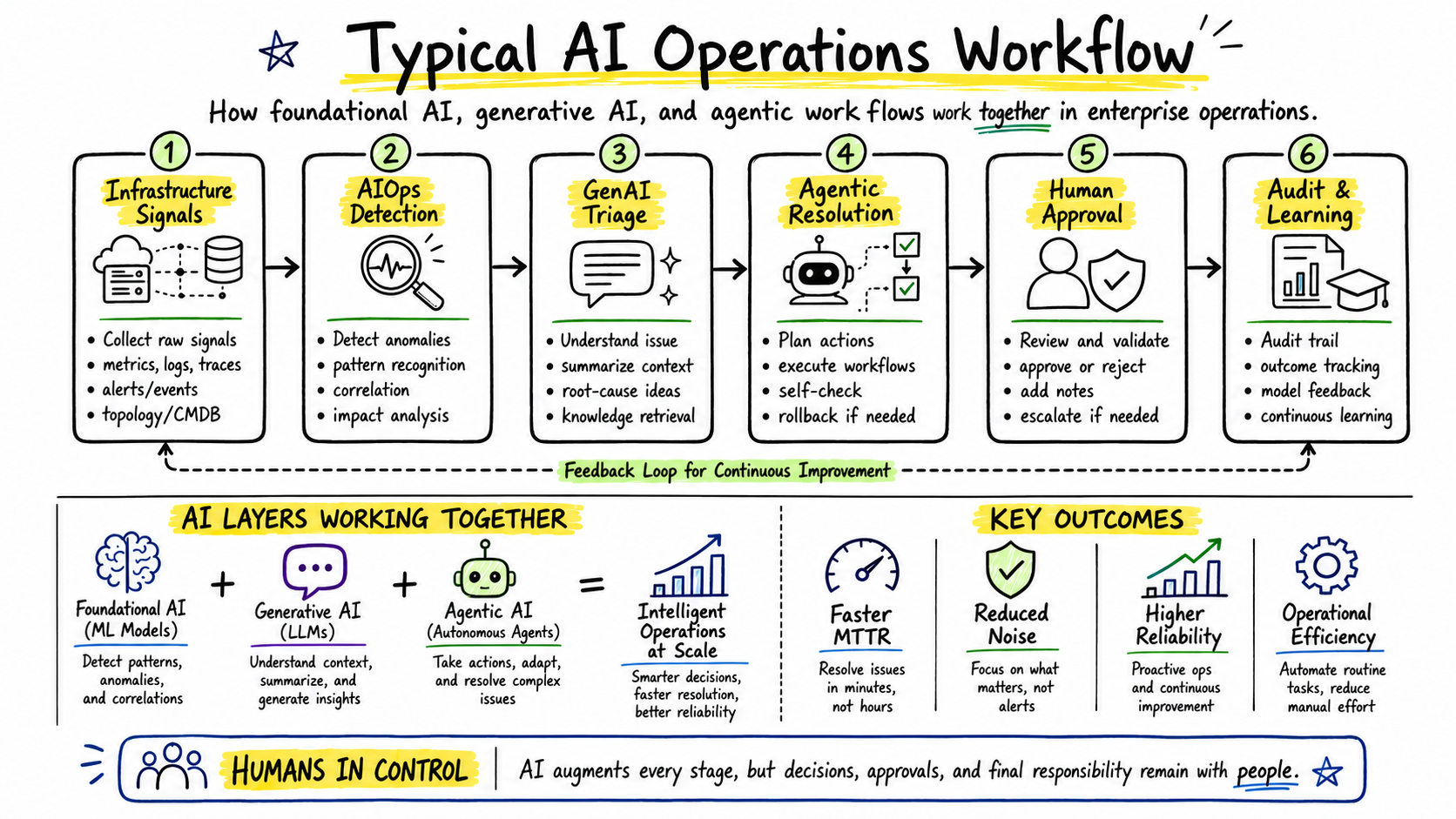
AI systems in this portfolio are treated as decision-intelligence layers, not uncontrolled execution layers. They classify operational signals, reason over infrastructure state, surface risk, and route recommendations into human-governed lifecycle workflows.
Signal Layer
Logs, test failures, deployment events, and change metadata are normalized into one infrastructure context stream.
Reasoning Layer
Hybrid engine uses retrieval, known-failure patterns, and policy gates to build an operational hypothesis.
Recommendation Layer
Produces ranked fixes, blast-radius estimate, and rollback-safe recommendations with human approval before execution.
Evaluation & Scope
Success criteria: faster MTTR, fewer repeat incidents, and fewer risky production changes.
Not AI for AI's Sake
AI assists. Engineers decide. Every system I build follows three core principles: it must be safe by design, fully auditable, and deliver measurable business value. AI in operations should enhance human decision-making, not replace human judgment.
flowchart LR
    S([Signals]) --> N[Normalize]
    N --> R{Reasoning}
    R --> Rec[Recommendation]
    Rec --> H{Human Approval}
    H -->|approved| A[Action]
    H -->|rejected| S
    A --> F[Feedback]
    F --> S
Operational Cognition & Intelligent Automation
Decision-intelligence systems that classify operational signals, reason over infrastructure state, and surface governed recommendations before issues impact users.
- Anomaly detection for metrics and logs
- Predictive scaling based on traffic patterns
- Intelligent alert correlation and noise reduction
- Root cause analysis acceleration
Governed AI & Assistants
Enterprise-grade AI governance ensuring safe, compliant, and controlled AI adoption across development teams.
- Policy-based guardrails for AI assistants
- Data loss prevention in AI workflows
- Usage analytics and compliance reporting
- Safe adoption playbooks and training
Advisory AI Systems
AI that advises rather than acts autonomously. Human-in-the-loop for critical decisions with full transparency.
- Recommendation engines with confidence scores
- Decision support with explainability
- Rollback capabilities on all AI actions
- Complete audit trails for compliance
MLOps & Model Governance
Production-grade machine learning and AI pipelines with proper versioning, monitoring, and governance throughout the model lifecycle. Covers both traditional ML and LLMOps patterns for governed operations.
- Model registry and version control
- Automated model validation and testing
- Drift detection and performance monitoring
- Bias detection and fairness metrics
Lifecycle Automation with Human Governance
Governed automation that adapts to changing conditions while preserving clear decision paths, validation, and human review.
- Self-healing infrastructure responses
- Automated incident triage and routing
- Intelligent deployment strategies
- Cost optimization recommendations
Conversational AI
Natural language interfaces for platform operations, making complex systems accessible to all team members.
- ChatOps for infrastructure management
- Natural language queries for observability
- Guided troubleshooting assistants
- Knowledge base integration
Generative & Agentic AI
From prompt engineering to multi-agent orchestration, including LLMOps and fine-tuning — building GenAI systems that integrate safely into enterprise infrastructure ecosystems
Generative AI (GenAI)
GenAI integrations for engineering workflows - code generation, documentation, incident summaries, and platform self-service through natural language.
- Assistant governance and usage policies
- Prompt engineering for platform operations
- GenAI-assisted runbooks and KB articles
- Output validation and hallucination controls
LLMOps & Evaluation
Architecture topics for evaluating and operating model-assisted workflows. These notes describe design considerations; the public artifacts remain browser prototypes.
- LLM evaluation frameworks (evals, benchmarks)
- Held-out questions and source-grounded evaluation
- Latency, cache reuse, cost, and quality monitoring
- Model version governance and rollback
Agentic AI Workflows
Reference patterns for multi-step advisory workflows, with bounded tools, explicit stop conditions, and human approval for operational changes.
- Multi-agent orchestration frameworks
- Tool-use and function calling patterns
- Agent memory and context management
- Human approval gates at critical steps
RAG & Knowledge Systems
Retrieval-Augmented Generation that connects LLMs to enterprise knowledge bases — so answers can be grounded in internal docs, runbooks, and code repositories.
- Vector database integration (pgvector, Weaviate)
- Document chunking and embedding pipelines
- Hybrid retrieval and query-aware reranking
- Versioned caches, source citations, and access controls
AI Cost Engineering
Model selection, token economics, and cost optimization for decision-intelligence systems at scale
Why AI Model Choice Matters
Compare quality, latency, and workload cost before choosing a model or routing strategy. The Token Ledger explains token assumptions and cost planning; provider prices and capabilities should be checked in current official documentation.
Workload Comparison
Evaluate candidate models against representative tasks, source requirements, latency, and current provider terms.
- Task-specific quality and latency targets
- Context size and data-handling requirements
- Input, output, and cache cost assumptions
- Provider documentation checked before use
Token & Cache Planning
Estimate input and output needs, then distinguish reusable prompt prefixes from retrieved evidence and stored answers. Each cache layer needs its own validity rules.
- Approximate token count estimation
- Per-request cost calculation
- Output ratio presets or custom ratios
- Cache hit, miss, write, and invalidation assumptions
Budget Scenarios
Use request volume, token assumptions, retry rates, retrieval overhead, and observed cache reuse to build a workload estimate.
- Requests per day and expected concurrency
- Input and output token configuration
- Daily, monthly, and annual cost projections
- Measured reuse and retry rates before savings claims
Explore The Token Ledger
Token usage, transparent assumptions, and workload cost planning
Future Systems Deep Dive
Advanced operational intelligence, governed autonomy patterns, and future-system governance now live in a dedicated article hub, leaving this page focused on applied enterprise decision-intelligence systems.
Open Future Systems HubAdvisory AI Signal Path
From operational signals to ranked recommendations: observable inputs, constrained reasoning, and human-reviewed output.
AI Safety & Governance
Non-negotiable principles for safe, compliant, auditable AI systems
Core Principles
Human-in-the-Loop
Critical decisions always require human approval. AI recommends, humans decide. No fully autonomous actions on production systems without explicit approval chains.
Full Explainability
Every AI recommendation includes reasoning. No black boxes. Teams understand why AI suggests specific actions, building trust and enabling better decisions.
Complete Audit Trail
Every AI action is logged with full context. Who approved, what data was used, what was the outcome. Essential for compliance and continuous improvement.
Graceful Degradation
When AI systems fail or become unavailable, operations continue safely. Manual overrides always available. AI enhances, never creates single points of failure.
Compliance & Regulatory Alignment
Regulatory Frameworks
- NIST AI Risk Management Framework
- ISO/IEC 42001 (AI Management)
- SOC 2 Type II compliance
- GDPR & data privacy requirements
Monitoring & Observability
- Real-time model performance dashboards
- Drift detection & alerting
- Cost tracking & optimization
- Bias & fairness metrics
Data Governance
- Data lineage & provenance tracking
- Access control & DLP policies
- Encryption & secure data handling
- Data retention & deletion procedures
Continue Learning
Dive deeper into specific areas of operational cognition and infrastructure intelligence
The Token Ledger
Token usage, workload assumptions, and educational cost-planning examples. This is not a live provider-pricing service.
Read The Token LedgerGrounded AI Systems
Compare retrieval, prompt and answer caching, CAG, and MCP. Explore source grounding, freshness, access scopes, and browser demonstrations.
Read ArticleOperational Standards
Concrete standards, checklists, and runbooks for implementing AI safely in production. From incident response to model deployment, operational governance that works.
View StandardsReady to Build Operational Intelligence
Discuss the use case, evidence requirements, operational constraints, and evaluation needed before deployment.
Get in Touch